Delaware vs Wyoming LLC Fees for Non-US Residents: 2026 Pricing Guide
Key Takeaways
- Wyoming is cheaper to establish and maintain, but its primary advantage is cost.
- Delaware requires a higher annual payment, but its flat fee remains predictable as the business grows.
- Delaware LLCs do not need to file annual reports, while Wyoming LLCs must complete an annual filing.
- Both states provide limited-liability protection and charging-order protection when the company is structured and operated correctly.
- Delaware offers a cleaner long-term privacy structure, greater legal certainty, and access to its Court of Chancery.
- For most non-US founders building a serious long-term business, Delaware remains the stronger overall choice.
- When opening a US LLC as a non-US resident, one of the first decisions is where to form the company.
Two states appear repeatedly in online comparisons: Delaware and Wyoming.
Wyoming is often promoted as the lower-cost option, while Delaware is sometimes described as a state that only makes sense for businesses seeking investment.
That comparison is too simplistic.
Cost matters, but the state with the lowest annual fee is not automatically the best place to establish a company.
A proper comparison should account for:
- Formation fees
- Annual state fees
- Registered-agent costs
- Ongoing filing requirements
- Privacy considerations
- Asset-protection rules
- Legal certainty
- Long-term business credibility
For founders who want a broader overview of the differences, our guide comparing Delaware and Wyoming LLCs explains the legal and structural considerations in more detail.
This pricing guide focuses on the real costs non-US entrepreneurs should understand before choosing between the two states.
Delaware vs Wyoming LLC Cost Comparison
Wyoming LLC Formation Fee: $100
Wyoming charges a $100 state filing fee to establish an LLC.
Online filings may include a small additional processing fee, bringing the total to approximately $102-$103.
This makes Wyoming attractive to founders who want to minimize the upfront cost of forming a US company.
Wyoming filings can be completed online through the Secretary of State. For straightforward LLC formations, the process is relatively simple.
Delaware LLC Formation Fee: $110
Delaware charges a $110 state filing fee to establish an LLC.
The difference between the Wyoming and Delaware formation fees is minimal.
A founder choosing between the two states is therefore not making a major financial decision at the formation stage.
The more meaningful difference appears in the annual maintenance costs and ongoing compliance requirements.
Annual LLC Costs: Delaware vs Wyoming
Delaware: Flat $300 Annual LLC Tax
Delaware LLCs must pay a flat $300 annual tax.
The payment is due by June 1 each year.
This fee does not increase based on:
This predictability is one of Delaware’s advantages.
A small consulting company and a fast-growing international business pay the same annual Delaware LLC tax.
Delaware LLCs also do not need to file an annual report with the Delaware Division of Corporations.
The annual state-level compliance process is therefore relatively simple:
- Maintain a registered agent
- Pay the fixed $300 annual LLC tax
- Complete any required federal and international tax filings
Although Delaware LLC costs are higher than Wyoming’s minimum annual fee, the flat payment remains predictable as the company becomes more successful.
Wyoming: $60+ Annual Report Fee
Wyoming LLCs must file an annual report each year.
The report is due by the first day of the anniversary month in which the company was formed.
For example, if an LLC was formed on 15 July, the annual report will generally be due by 1 July each year.
The Wyoming annual-report fee is calculated as the greater of:
- $60, or
- 0.0002 multiplied by the value of the company’s assets located and employed in Wyoming
This distinction matters.
The fee is not automatically based on the total value of an online business or the company’s global valuation.
For many non-US residents operating remote businesses without meaningful assets located in Wyoming, the minimum $60 payment will apply.
Wyoming is therefore cheaper than Delaware for many small online businesses.
However, Wyoming LLCs must still complete an additional state filing each year. Business owners can access the Wyoming Secretary of State annual-report portal to submit the required report.
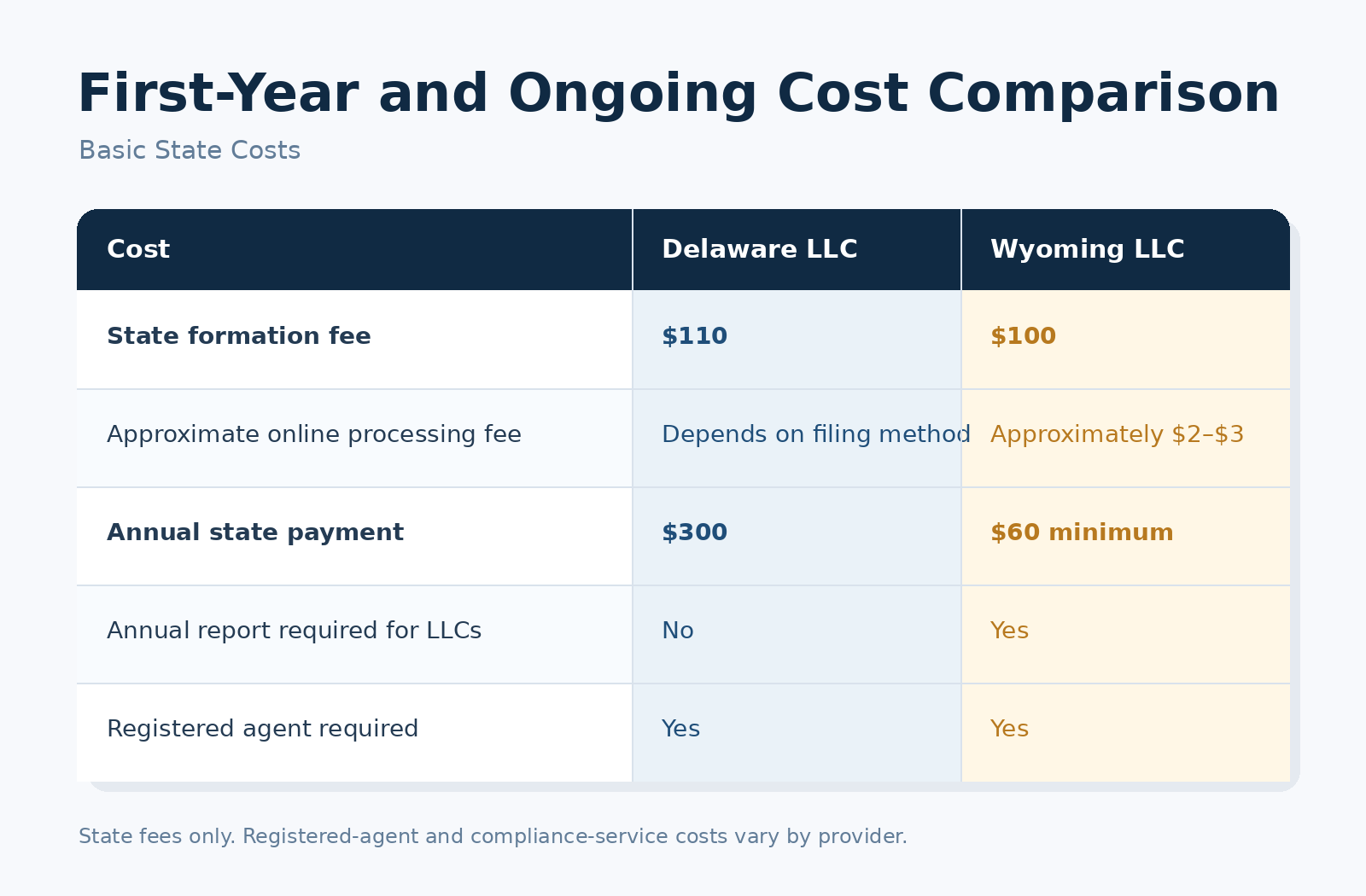
Wyoming is clearly cheaper when comparing the basic state fees alone.
However, the lowest state fee should not be the only factor considered.
The practical cost of operating an LLC may also include:
- Registered-agent services
- Mail-forwarding services
- Business-address services
- Formation support
- Bookkeeping
- Federal tax preparation
- IRS compliance
- Banking support
- Privacy-related services
- Nominee services in certain circumstances
- A lower state fee can become less meaningful when additional services are needed to maintain the desired structure.
Registered Agent Costs
Both Delaware and Wyoming require LLCs to appoint a registered agent.
A registered agent receives official notices and legal documents on behalf of the business in the state where the company is formed.
This is particularly important for non-US residents who do not have a physical presence in the United States.
Registered-agent fees vary depending on the provider and the level of support included.
A basic registered-agent package may only include document receipt and forwarding.
A more complete service may also include:
- Formation assistance
- Compliance reminders
- Mail forwarding
- Business-address services
- Document handling
- Annual-maintenance support
- Banking guidance
- Ongoing support for non-US founders
The Delaware Division of Corporations publishes an official list of Delaware registered agents. VALIS Group Inc. appears under the letter “V” in the directory.
When comparing providers, founders should look beyond the lowest advertised price.
A non-US founder may need more support than a US resident who already understands the state and federal compliance requirements.
Privacy Considerations
Privacy is one of the most misunderstood parts of the Delaware vs Wyoming LLC comparison.
Wyoming is frequently promoted online as the obvious privacy choice.
However, Delaware offers a clean long-term privacy structure that is often overlooked.
Delaware LLC Privacy
Delaware does not require the names of members or managers to appear in the Certificate of Formation.
The primary public information generally includes:
- The LLC name
- The registered-agent information
- The registered office
- The formation details
Delaware LLCs also do not file annual reports.
This removes an additional recurring filing point that could otherwise require careful management each year.
For founders who value long-term separation between their personal information and public company records, Delaware provides a simple and predictable structure.
Wyoming LLC Privacy
Wyoming also offers privacy at the formation stage.
Member and manager names are not generally required in the Articles of Organization.
However, Wyoming LLCs must file annual reports.
The annual-report requirement does not automatically mean that every owner’s personal details will become public.
However, founders who want to avoid personally appearing in connection with the filing may need someone, such as their registered agent, to submit the annual report on the company’s behalf.
This creates an additional annual compliance obligation and another filing point that must be handled correctly.
Depending on the structure of the business and the information used in its filings, a founder may require:
- Registered-agent service
- A separate business address
- Mail-forwarding services
- Additional privacy-related support
- A nominee arrangement in certain circumstances
- These services can add cost and complexity.
Wyoming’s lower annual state fee is therefore most attractive to founders who prioritize cost savings and are comfortable managing the additional filing requirements.
Asset Protection: Is Wyoming Actually Better?
Wyoming is often promoted as the stronger state for asset protection.
The claim usually focuses on charging-order protection.
However, the comparison is more nuanced.
Limited Liability in Both States
Both Delaware and Wyoming LLCs provide limited-liability protection when the company is properly structured and operated.
This protection is designed to separate the obligations of the business from the personal assets of its owner.
However, an LLC is not a magic shield.
Founders should:
- Keep company and personal finances separate
- Use a dedicated business bank account
- Sign contracts in the LLC’s name
- Maintain proper accounting records
- Complete required tax filings
- Keep company documentation organized
- Avoid using the company for personal transactions without proper recording
Proper administration matters regardless of the state chosen.
Charging-Order Protection in Delaware and Wyoming
A charging order generally limits the remedies available to a creditor pursuing an LLC member’s economic interest in a company.
Wyoming provides charging-order protection.
Delaware does too.
Delaware and Wyoming statutes both provide explicit charging-order protections for single-member and multi-member LLCs. In both states, the charging order is the exclusive remedy available to a judgment creditor pursuing a member’s LLC interest, limiting foreclosure and the seizure of the LLC’s underlying assets.
Wyoming law specifically bars court-ordered directions, accounts, and inquiries. Delaware, meanwhile, utilizes its specialized Court of Chancery for charging-order matters and other business disputes.
For full details on Delaware’s statutory language, read the Delaware Code.
This is especially relevant to non-US founders, who often establish single-member LLCs.
Wyoming should therefore not automatically be treated as the superior asset-protection state.
Both states offer meaningful protections when the LLC is correctly structured and managed.
Delaware’s Legal Advantages
Delaware’s higher annual cost should be viewed in the context of its broader legal framework.
The Delaware Court of Chancery is one of the state’s most important advantages.
This specialized business court handles complex corporate and commercial disputes.
Its judges have deep experience in business law, and the state has developed an extensive body of legal precedent.
This provides:
- Greater legal certainty
- More predictable outcomes
- A sophisticated environment for resolving disputes
- A well-developed body of company law
- Greater confidence for partners and investors
- A clearer path for businesses planning to scale
These advantages do not only matter to venture-backed startups.
They can also become relevant when a business:
- Adds a partner
- Enters into a major agreement
- Brings in an investor
- Sells part of the company
- Creates a joint venture
- Expands internationally
- Resolves a commercial dispute
The best state is not merely the cheapest option when the company is formed.
It is the state that remains suitable if the business succeeds.
Why Delaware Is Trusted by Businesses of All Sizes
Delaware is not only used by large corporations.
It is also home to a substantial number of LLCs and small businesses.
According to the Delaware Division of Corporations’ official business-entity statistics, the state had more than 2.1 million active business entities at the end of 2024.
The same official report states that:
- More than two-thirds of Fortune 500 companies are incorporated in Delaware
- 81.4% of US-based companies that launched an initial public offering in 2024 chose Delaware as their corporate home
- Delaware recorded 289,810 new business-entity formations in 2024
- LLCs accounted for 211,464 of those formations
The statistics demonstrate that Delaware serves businesses at different stages of growth.
Its legal framework is not only relevant to companies seeking investment.
It is also useful for founders who want a predictable, credible, and scalable US company structure.
State Tax Considerations
Forming an LLC in Delaware or Wyoming does not automatically determine the company’s full tax position.
The actual outcome depends on factors such as:
- Where the owner lives
- Where the work is performed
- Whether the LLC has employees in the United States
- Whether the company stores inventory in the United States
- Whether the company has an office or physical presence
- Whether it sells taxable goods or services
- Whether it creates nexus in another US state
- Whether the owner has tax obligations in their country of residence
The formation state is only one part of the tax analysis.
A founder should not choose Delaware or Wyoming based on the assumption that the state alone determines the company’s total tax obligations.
Federal Filing Requirements for Non-US LLC Owners
State formation is only one part of US company compliance.
Non-US founders should also understand their federal filing obligations.
Beneficial Ownership Information Reporting
The Corporate Transparency Act rules changed significantly in March 2025.
Entities formed in the United States are currently exempt from beneficial ownership information reporting to FinCEN.
Foreign companies formed outside the United States and registered to do business in a US state may still have reporting obligations.
IRS Form 5472 and Pro Forma Form 1120
A foreign-owned US disregarded entity may need to file IRS Form 5472 together with a pro forma Form 1120 when reportable transactions occur.
This commonly affects non-US residents who own single-member LLCs.
Reportable transactions may include funds moving between the owner and the LLC.
Failure to file a complete and accurate Form 5472 by the required deadline may result in a $25,000 penalty.
These filing requirements can apply regardless of whether the LLC is formed in Delaware or Wyoming.
Non-US founders should work with professionals who understand the compliance obligations associated with foreign-owned LLCs.
When Wyoming May Make Sense
Wyoming is not a bad state for LLC formation.
It can be a reasonable option when minimizing the annual state fee is the founder’s main priority.
A Wyoming LLC may suit founders who:
- Want the lowest possible annual state fee
- Operate a small and straightforward online business
- Are comfortable filing an annual report each year
- Are comfortable managing any privacy considerations
- Do not expect to seek outside investment
- Do not require Delaware’s legal framework
- Understand that Wyoming’s main advantage is cost
For certain small businesses, saving approximately $240 per year may be worthwhile.
However, founders should make that decision with a clear understanding of the trade-offs.
Why Delaware Is Usually the Better Choice
Delaware is generally the stronger long-term option for non-US entrepreneurs.
It provides:
- No annual-report filing requirement for LLCs
- A fixed and predictable $300 annual LLC tax
- A clean privacy structure
- Limited-liability protection
- Charging-order protection
- Access to the Court of Chancery
- A well-established body of business law
- Greater credibility with partners and service providers
- A structure that remains suitable as the company grows
Wyoming is cheaper.
Delaware is more complete.
The additional annual cost is relatively modest when compared with the benefits of a cleaner privacy structure, greater legal certainty, and a company formation that does not need to be reconsidered as the business becomes more successful.
Final Verdict: Delaware vs Wyoming LLC Fees
For most non-US founders, Delaware is the better long-term choice.
Wyoming remains a reasonable option for entrepreneurs who care primarily about minimizing annual state fees.
However, Wyoming should not automatically be treated as the superior state for privacy or asset protection.
Both states offer limited-liability and charging-order protection.
Delaware combines these protections with a cleaner ongoing privacy structure, no annual-report filing requirement for LLCs, a fixed annual tax, and access to one of the most respected business-law systems in the United States.
Founders who need help choosing the right structure can work with VALIS International to establish and maintain a US company from abroad.